


Original posted on WHO, February 24, 2024
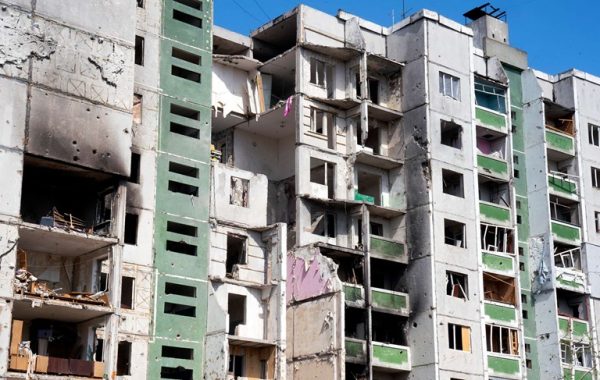
Photo credit: WHO/Christopher Black.
since the escalation of the war
are currently internally displaced
have been killed
have been injured
on Ukraine’s health-care system
have been killed
___________________________________________________________________________________
As a consequence of war, the Ukrainian health system continues to operate under extreme pressure. Despite its resilience, ongoing challenges make it difficult to support the heavy burden of complex trauma patients, which necessitates medical evacuations (medevac).
Since March 2022, the Ministry of Health of Ukraine’s Medevac Coordination Unit has successfully managed and coordinated over 3500 medical evacuations abroad for patients who required specialist trauma treatment, and oncology, rehabilitation or prosthetic care.
Multiple partners and a complex series of steps are needed to safely transport patients from the first point of care to specialized services in country or abroad.
In January 2023, WHO/Europe responded to a direct request for assistance from Ukraine to support the voluntary return of patients following their treatment abroad. Funding was secured from the European Commission Service for Foreign Policy Instruments and an 18-month medevac and repatriation project was established with the Ministry of Health of Ukraine.
WHO continues to provide technical and operational guidance to the Ministry of Health’s Medevac Coordination Unit, as they further establish themselves as a dedicated project office with 27 operational staff in Kyiv and in other key oblasts.
Since June 2023, the Ministry of Health has coordinated and managed the safe return of 287 patients, of which 23 required specialized medical repatriation transportation provided by project partner Deutsche Flugambulanz.
The Lviv Regional Center for Emergency Medical Care and Disaster Medicine has been enabled to lead on all cross-border patient transfers. Close collaboration is in place with the Medevac Hub Jasionka and several other stakeholders involved in medical evacuation and repatriation. A unique partnership with the charitable foundation Medical Mission enables these operations.
Around 250 interhospital transfers have been supported by project partner Artesans-ResQ, who are embedded within the emergency medical services (EMS) in Dnipro. Of these transfers, 191 were critical patients who required ventilation support during travel. Over 31 918 km have been travelled in transporting such high-risk patients.
Fifty-three EMS staff, at least 2 from each of the 24 oblasts, have completed the participant–internship–instructor critical care training pathway implemented by Artesans-ResQ in close collaboration with the Ukrainian Scientific and Practical Center of Emergency Medical Care and Disaster Medicine.
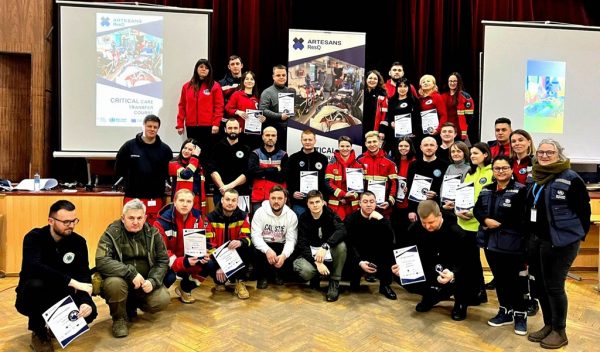
Photo credit: Artesans Res-Q. Ukrainian EMS participants graduate from the critical care transportation course, Dnipro, February 2024.
“The training has shown that standardization of clinical protocols in critical care transfers is crucial. Having procedures and protocols in place, we will be able to train medical staff involved in patient transportation accordingly and apply the standardized procedures at each stage of patient care, during transportation and handover. Thanks to this, we will have shared protocols not only with local doctors from other teams and regions but also with doctors from abroad. This will help us act faster and improve the quality of assistance provided.” – Dorosheva Nataliia, Head of the Training Department of the Center for Emergency Medical Care and Disaster Medicine of Zaporizhzhia Oblast
“Transportation of an intensive care patient can cause a lot of stress. When medical staff are not familiar with critical care transportation protocols, this can contribute to stress levels. Being familiarized with the protocols, we now know how to conduct a handover and manage an intubated patient during transportation, and how to monitor the patient’s status. We know precisely which critical points to pay attention to. That increases patient safety and helps medical staff manage stress levels.” – Snizhana Holub, Doctor of Emergency Medical Care and Emergency Conditions, Poltava
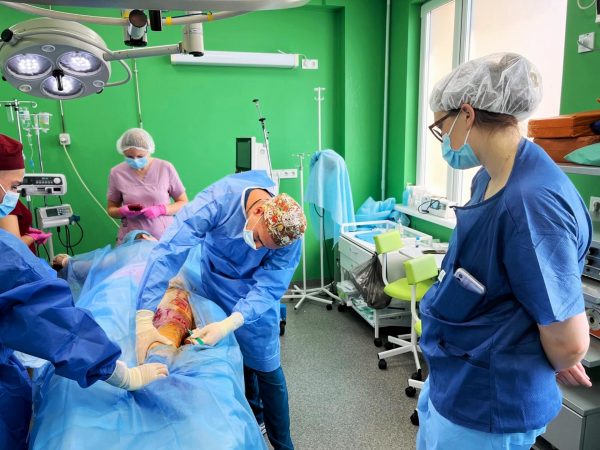
Photo credit: Global Response Medicine. Ukrainian burns centres receive support from international experts in burn care, November 2023.
Clinical teams across several hospital sites in the eastern part of Ukraine have been supported with access to specialist trauma surgery and burns care expertise provided by project partner Global Response Medicine; 111 acute trauma cases have been consulted on.
Nine fellows have each received 110 days of intensive trauma care training. Some of them experienced, an immersive clinical exchange at the University of Chicago for shared learning with Global Response Medicine.
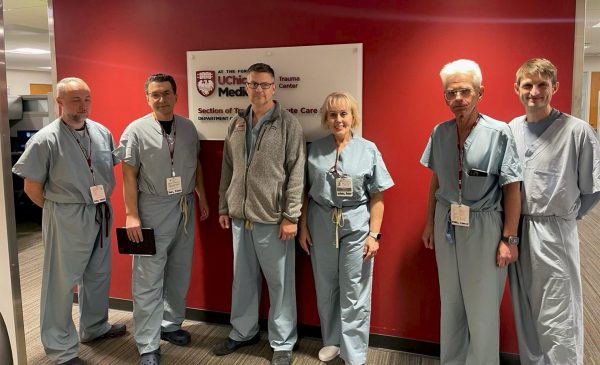
Photo credit: Global Response Medicine. University of Chicago hosted Ukrainian trauma surgery experts for a clinical observership, December 2023.
“During an internship at the University of Chicago, we had the opportunity to observe the work of surgeons on patients with polytrauma, as well as how the communication system between medical units is set up. We came back with ideas and motivation to improve our practices and processes.” – Viktoriia Korpusenko, General Director of the Clinical Emergency Hospital of the Dnipro City Council
Despite the challenges and impact that the escalation of the war has had on the Ukrainian health-care system, many partnerships and collaborations have been made in response to the Ministry of Health’s request to support medical evacuations and repatriations.